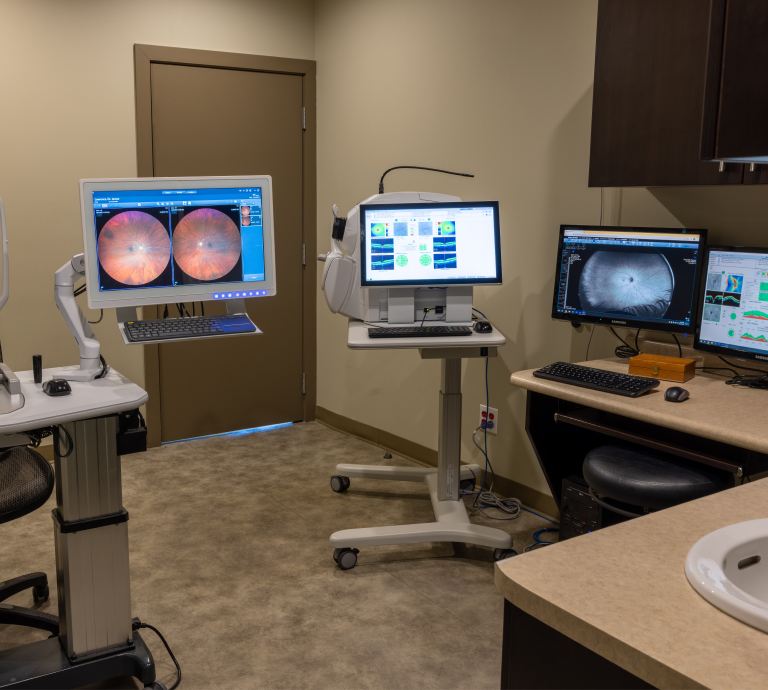
Technology-Supported Eye Exams
At River Valley Eye Care, we invest in key eye care technologies that enhance our standard of care and help us monitor for subtle changes in vision or eye structures that could indicate a serious vision problem.
From detecting and monitoring signs of myopia in children to managing vision-threatening conditions like glaucoma, cataracts, and diabetic eye disease, our technology supports our goal to protect what matters most: your visual health.
Learn more about the different devices we use in our comprehensive eye exams, eyewear fittings, and myopia management program, as well as our philosophy behind why we use these devices.
Why We Invest
in Technology
[Insert Dr. Lawrence’s philosophy]
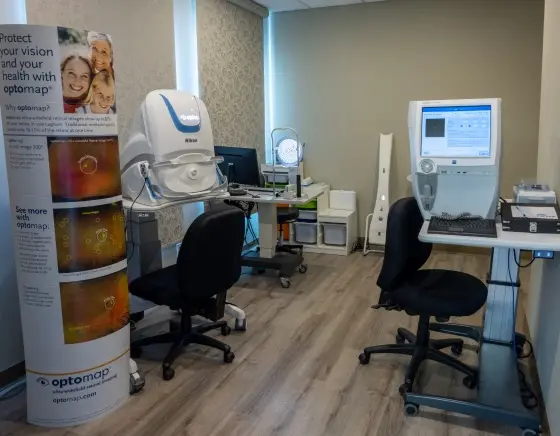
Diagnostic Technologies
Diagnostic technologies are devices we use to assess your eye health and monitor for signs of vision problems, like nearsightedness, farsightedness, and astigmatism, as well as for signs of eye disease, like glaucoma, macular degeneration, and cataracts.
Our complete suite of diagnostic technologies is located at our North Battleford location; however, we do offer Optomap retinal imaging and Tono-Pen tonometry at our Unity location.
Learn more about how our devices make your visit easier.
Corneal topography helps us assess the curvature and health of your cornea. This is the clear, dome-shaped part of your eye that sits in front of your iris and pupil. It is an important part of fitting contact lenses.
Our corneal topographer also includes a keratograph that examines the meibomian glands, measures non-invasive tear film break-up time, measures the tear meniscus height, and assesses the lipid layer.
These measurements are essential for helping us detect issues like keratoconus and dry eye.
Ultra-widefield retinal imaging gives us a highly detailed look at the inside of your eye. The eye is lined with a thin tissue called the retina, which is responsible for receiving the light that enters your eyes (i.e., capturing the images that you can see). We use the Optomap camera at Unity and the ZEISS CLARUS fundus camera at North Battleford.
Using this technology, we can look for signs of eye diseases like macular degeneration, glaucoma, and diabetic retinopathy.
It can also help us detect potential health concerns affecting your overall well-being, such as early signs of diabetes, hypertension, and heart disease.
Optical coherence tomography (OCT) is an imaging technique we may use to examine internal structures of your eye. This device uses light to help create cross-sectional images of your retina, optic nerve, and blood vessels, similar to images in an ultrasound.
Some concerns it can help detect include macular degeneration, glaucoma, and diabetic retinopathy.
We can also use the OCT for anterior segment imaging, which maps the front part of the eye. This can help us detect signs of glaucoma, cataracts, and keratoconus, among other concerns.
Tonometry is the measurement of the pressure inside your eye.
Your eye is filled with a fluid called the vitreous gel. When your eye is healthy and functioning normally, this fluid maintains a consistent pressure that keeps your eye round and healthy. However, sometimes accidents and injuries, or conditions such as glaucoma, can cause an increase in eye pressure that can damage your vision.
We use the Tono-Pen device to quickly and accurately measure your internal eye pressure during both comprehensive eye exams and emergency appointments.
Your visual field refers to the entire field of view you can see without moving your eyes. In other words, your visual field includes both your central vision (what your eyes are focused on) and your peripheral vision (side vision).
We use the ZEISS FDT field bowl device to measure your visual field objectively. This is important, as conditions such as glaucoma can affect your vision very gradually and impact your peripheral vision first, so you may not notice these changes until significant vision loss has occurred.
By tracking your visual field using the FDT device, we can compare your measurements from one year to the next, keeping an eye out for any changes.
Ocular biometry measures key biological indicators of the eye, including axial length and corneal curvature.
The axial length is a measurement of the eye from front to back. This is important for monitoring childhood myopia, as nearsightedness can cause the eye to grow longer than it should. Curvature of the eye can also affect refraction and cause myopia.
We use the IOLMaster by ZEISS for our myopia management program to track changes in your children’s vision over time and to assess how effective their treatment plan is. It also allows us to measure children’s eyes and determine their risk for developing myopia in the future.
Prescriptions and Glasses Fittings
Our eye care technology is not only used to monitor your eyes for health conditions. We also use innovative technologies to help us determine your prescription and design your new eyeglass lenses to match your anatomy for clear vision.
We use digital refractors to measure your prescription and the iTerminal device to seamlessly convert this prescription into your new eyewear.
Digital refractors give us precise vision testing information to help provide clear vision with your lens prescription. It allows us to digitally measure whether you are nearsighted or farsighted, and get close to your exact prescription.
For children who are too young to answer whether they prefer “1 or 2”, a digital refractor measurement can allow us to provide them with glasses to improve their vision. And for everyone else, it makes your appointment smoother and easier, as you will only need to answer a few questions to pinpoint the clearest vision we can achieve.
Both our North Battleford and Unity locations use the iTerminal to get an accurate measurement for your glasses.
When you are fitted for new glasses, an optician needs to check the fit and mark where your pupils sit within the frames. This allows us to craft your lenses around your unique focal point, so your vision is clear and comfortable.
The iTerminal device maps this measurement digitally, allowing us to gain a more precise measurement of your eyes and tailor your prescription to the frames and lenses of your choice.
Protecting Your Eye Health Through Technology
Our eye care technologies support a professional assessment by one of our experienced optometrists. These devices enhance our standard of care, allowing us to see your eye health on a deeper level, investigate concerns earlier, and make the whole process easier for you. Our eye doctors enjoy showing you the results of your tests, so you can see the pictures of the inside of your eye or the map we created of the curvature of your cornea.
Our goal is to make your eye care experience as simple and stress-free as possible, and our technology helps us achieve this. If you are interested in seeing our technology in action or have any questions about the devices used during your comprehensive eye exam, we’re happy to assist!
Brands We Carry











Visit Us in North Battleford or Unity
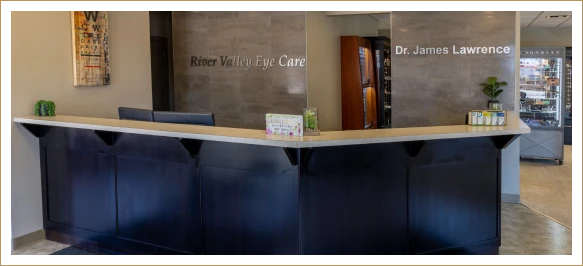
North Battleford
Address
- 1471-100 Street
- North Battleford, SK S9A 0W1
Contact Information
- Phone: 306-445-4451
- Email: info@rivervalleyeyecare.com
Hours of Operation
*Closed from 12:00-12:45 PM for lunch
Unity
Address
- 264-2 Ave West
- Unity, SK S0K 4L0
Contact Information
- Phone: 306-228-2722
- Email: info@rivervalleyeyecare.com
Hours of Operation
*Closed from 12:00-12:45 PM for lunch
**Contact the clinic for doctor availability. See social media for updated weekly hours.
About Us
Specialty Eye Care
Eyewear & Contacts
Our Locations
North Battleford
- 1471-100 Street
- North Battleford, SK S9A 0W1
Unity
- 264-2 Ave West
- Unity, SK S0K 4L0
Contact Us
North Battleford
- Phone: 306-445-4451
- Email: info@rivervalleyeyecare.com
Unity
- Phone: 306-228-2722
- Email: info@rivervalleyeyecare.com